مستمرين معاكم بإذن الله 2008-2026 **** #لان_لجيشنا_تاريخ_يستحق_أن_يروي
**** ***** إنشروا تاريخنا وشاركونا في معركة الوعي **** تابعونا علي قناة اليوتيوب 1100+ فيديو حتي الان **** تابعونا علي صفحات التواصل الاجتماعي** أشتركوا معنا في رحلاتنا لمناطق حرب أكتوبر **** يرجي استخدام خانة البحث
**** *** تابعونا علي تليجرام - انستجرام - تويتر
Meteor High-Level Egyptian–French Military Cooperation
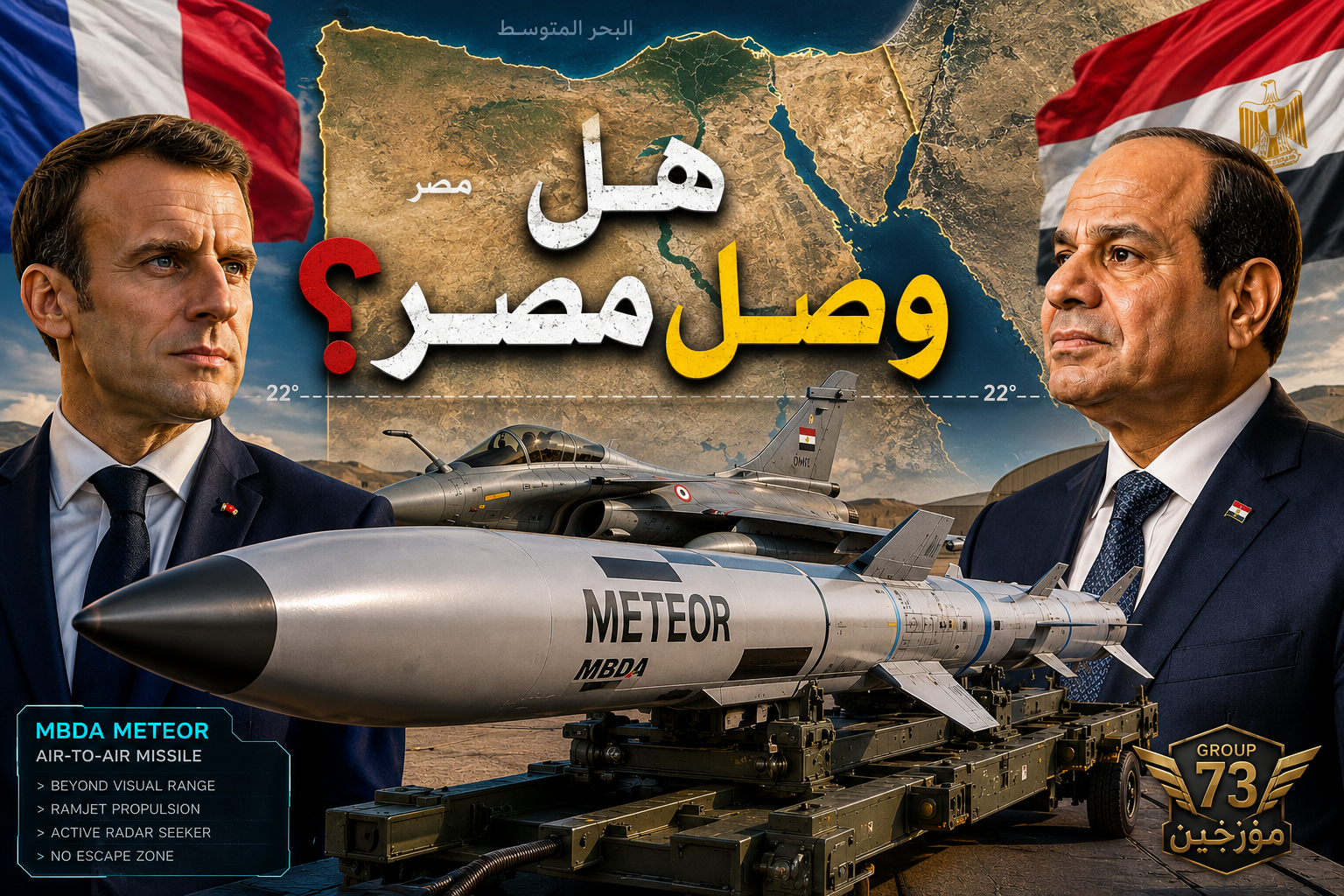
High-Level Egyptian–French Military Cooperation
By: Lamia Mahmoud
Egyptian–French cooperation represents one of the oldest and most significant international partnerships in Egypt's modern history. Its roots extend back to the arrival of the French Expedition in Egypt in 1798 and continued through the era of Muhammad Ali Pasha, during which France played an important role in the establishment of the modern Egyptian state. This partnership is far from being a recent development; rather, it is built upon centuries of historical, cultural, scientific, and civilizational ties that have gradually evolved into a comprehensive strategic and military partnership.
France has recently reinforced this relationship by providing Egypt with one of Europe's most advanced air-to-air weapons: the MBDA Meteor missile. The Meteor is regarded as one of the world's most capable Beyond Visual Range (BVR) air-to-air missiles. Israel closely monitors any potential Egyptian acquisition of this system, fully aware that its introduction into Egyptian service would represent a major leap in the operational capabilities of the Egyptian Air Force and significantly reduce the long-standing technological gap between Egypt and Israel.
The possibility of Egypt acquiring the Meteor also represents a strategic alternative to decades of American restrictions. For many years, the United States refused to supply Egypt with the advanced AIM-120 AMRAAM missile in order to preserve Israel's technological and military superiority in the region.
For more than four decades, Cairo repeatedly requested access to the AIM-120 AMRAAM, a long-range air-to-air missile that has equipped the Israeli Air Force for nearly thirty years. Despite approving sales of the same missile to several Gulf states—including the United Arab Emirates, Saudi Arabia, Qatar, Bahrain, and Kuwait—the United States has consistently declined Egypt's requests.
Egypt even proposed purchasing the ground-launched version of the AMRAAM mounted on HMMWV (Humvee) vehicles. That proposal was likewise rejected by Washington.
This raises an important question: Why has the United States remained so determined to deny Egypt access to this capability?
As a result, Egypt relied for decades on the AIM-7 Sparrow, a missile whose performance represented only an incremental improvement over the version already fielded by Israel during the War of Attrition, with an effective range of approximately 15 kilometers. This illustrates the enormous technological disparity that U.S. export policy deliberately created between Egyptian and Israeli air combat capabilities, particularly in the field of air-to-air weaponry, in order to preserve Israel's qualitative military edge.
Air combat has long been governed by a famous principle:
"First Look, First Shot, First Kill."
However, with the arrival of the European Meteor missile, that principle has evolved. The question is no longer who fires first, but rather whether the target has any realistic chance of escaping.
Why has the Meteor become one of the most discussed air-to-air missiles in modern military aviation? What distinguishes it from its competitors? Does it truly deserve its reputation? And has Egypt actually received the Meteor?
Traditionally, air-to-air missiles relied on solid-fuel rocket motors. These engines produced tremendous thrust immediately after launch before burning out within the first few seconds of flight. From that point onward, the missile depended solely on the kinetic energy it had already accumulated. Consequently, as the missile approached its target, it gradually lost energy, speed, and maneuverability, increasing the target's chances of escaping through aggressive maneuvering or electronic countermeasures.
This limitation inspired engineers to develop a new generation of missiles capable of defeating increasingly advanced fighter aircraft.
The Meteor follows an entirely different design philosophy.
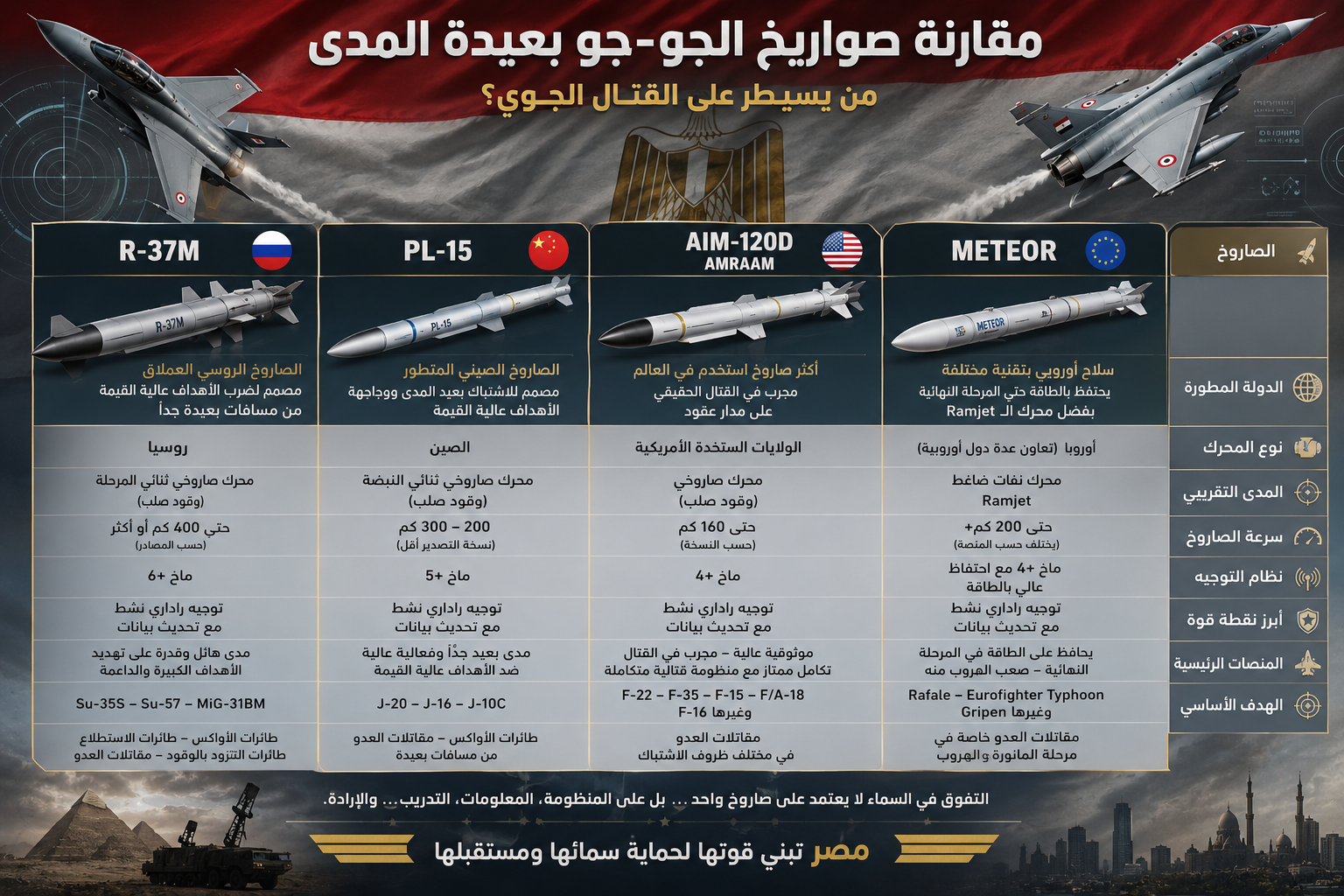
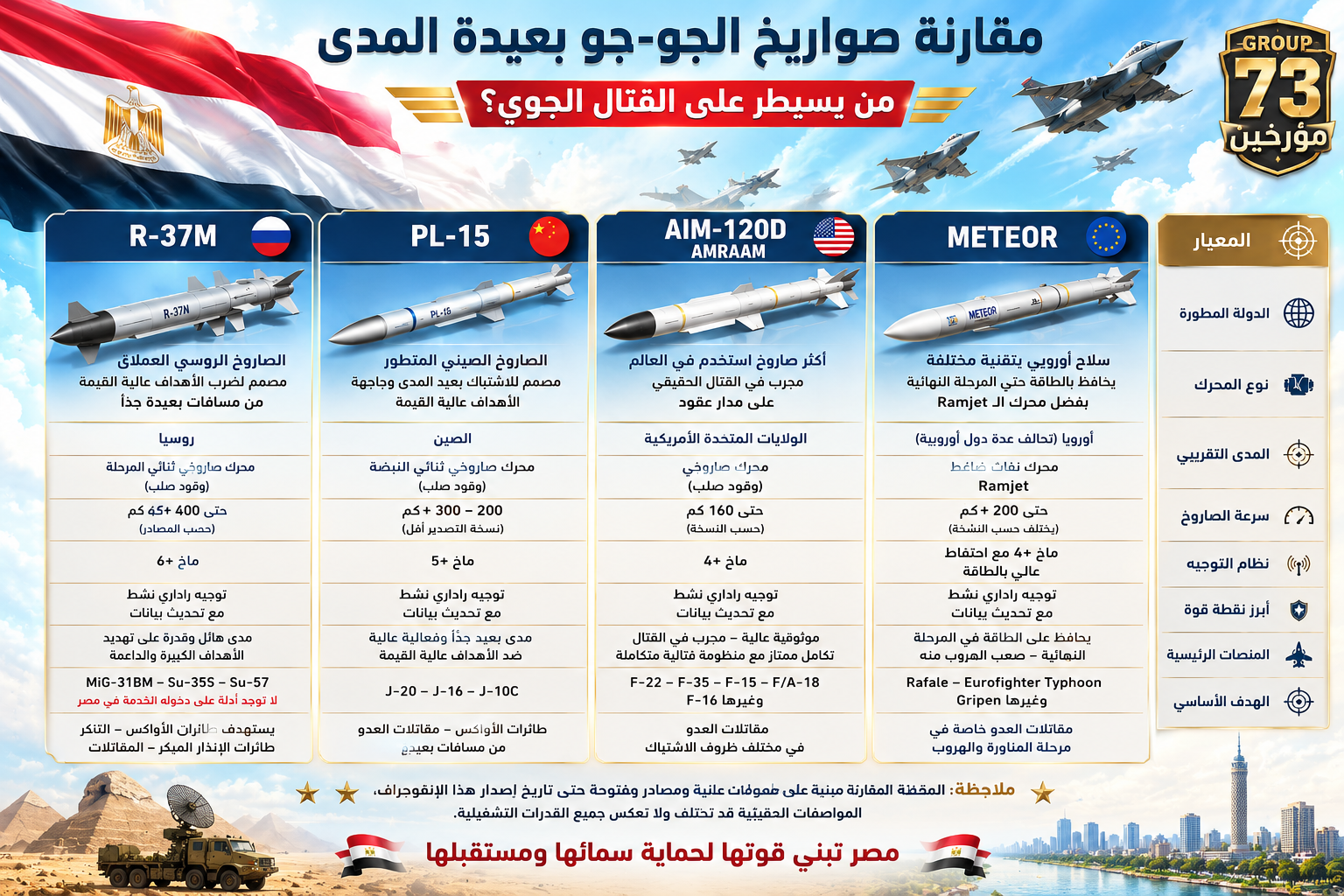
Instead of relying exclusively on a conventional rocket motor, it employs an advanced throttleable ramjet engine, enabling the missile to maintain powered flight throughout a significant portion of its trajectory. With an engagement range exceeding 200 kilometers, the Meteor preserves far more energy during the terminal phase of flight, making it considerably more difficult to evade—even against targets executing maximum evasive maneuvers or employing sophisticated electronic warfare systems.
The missile is capable of speeds exceeding Mach 4. It also features a very large No-Escape Zone (NEZ), significantly reducing the probability of target survival. An active radar seeker combined with a two-way datalink allows continuous target updates throughout flight, making the missile highly effective against agile fighter aircraft as well as high-value support assets such as airborne early warning and control (AEW&C) aircraft and aerial refueling tankers.
For these reasons, the Meteor has earned exceptional recognition among air forces and defense analysts worldwide. Nevertheless, like any advanced weapon, its true effectiveness depends on being integrated into a complete combat system operated by highly trained pilots, supported by capable radar systems and sound tactical doctrine.
Possessing advanced weaponry alone does not automatically make a nation militarily superior or guarantee victory in combat. Success ultimately depends upon well-trained personnel, sound military education, professional doctrine, and continuous operational training that enables those weapons to be employed to their full potential.
Likewise, sophisticated weapons require professional armed forces capable of operating, maintaining, and sustaining them over the long term. They should never be acquired merely for political prestige, media attention, commercial interests, or electoral considerations.
Unfortunately, while several wealthy Arab states—particularly in the Gulf—possess highly advanced military equipment, many still face challenges in independently operating, maintaining, and developing these systems.
This became particularly evident as the United States gradually reduced its direct military involvement in the Gulf while focusing on protecting Israel during the regional confrontation with Iran. Several American-made air defense systems struggled to intercept numerous Iranian missile attacks, exposing vulnerabilities despite the region's extensive inventory of some of the world's most advanced American weapon systems.
This naturally leads to the question that occupies the minds of military aviation enthusiasts and defense observers alike:
Which is the superior long-range air-to-air missile?
Is it the European Meteor, the American AIM-120 AMRAAM, China's PL-15, or Russia's formidable R-37M?
From a purely technical perspective, the European Meteor is widely regarded as one of the most capable beyond-visual-range air-to-air missiles currently in service. Its unique throttleable ramjet propulsion system enables it to maintain exceptionally high energy throughout the engagement, allowing it to retain lethal maneuverability even during the final stage of interception while engaging targets at ranges well beyond 100 kilometers.
In reality, France has demonstrated a willingness to provide Egypt with advanced military technology that Cairo considers essential to strengthening its defense capabilities. Unlike certain suppliers that impose restrictive export configurations or political conditions, French defense cooperation has increasingly been viewed in Egypt as offering greater operational flexibility and fewer political constraints.
Source: Group 73 Historians .
.png) |
 |
 |
 |
الأكثر قراءة
أخر الموضوعات
- بطولة الكتيبة 183 صاعقة - الكتيبة الشهيدة
- تنظيم كمين السرية الثالثة/ الكتيبة ١٠٣ صاعقة ضد رتل مدرع للعدو صباح يوم ١٥ أكتوبر ٧٣م شرق مدينة بورفؤاد
- أغاني وطنية بالذكاء الصناعي
- شهيد أسمة فتوح محمد حسين خليفه حميد
- Il missile Meteor, il più potente al mondo, è arrivato in Egitto? La nuova sfida agli equilibri militari del Medio Oriente